In last week’s article we started to look at a five-step grooming process that certain predatory individuals use. The five steps are: 1) target selection, 2) trust building, 3) isolation, 4) desensitization, and 5) exploitation. The first part looked at the target selection, and trust building phases/stages/component of the grooming process whilst this article will look at the last three.
Isolation doesn't initially mean physically removing someone from everyone else around them. This would be too obvious. In most cases, it initially starts by gradually weakening the influence of the people in the target’s life who might challenge the relationship between the groomer and their target, as it develops. The groomer may encourage the idea that the relationship is unusually special e.g., “Nobody understands you the way I do,” or “Other people wouldn't understand what we have.” Friends and relatives may be subtly portrayed as controlling, jealous, immature, or unsupportive i.e., individuals who don’t have the target’s best interests at heart. Communication can start to move into private spaces, whether that means spending time alone together or shifting online conversations from public platforms, with friends/family into private messages etc. One of the powerful tools that groomers use is that of “secrets” (something I wrote about as it relates to CSA – Child Sexual Abuse). Initially these secrets may appear harmless e.g., an undisclosed gift, an inside joke, a conversation that “doesn't need to be mentioned” etc. The content may matter less than establishing the principle that certain things belong exclusively to the relationship. Once secrecy becomes normal, concealing more serious behavior becomes psychologically easier. We should be suspicious of adults who repeatedly create unnecessary secrecy or create/develop relationships which are exclusive with people they have power over.
Desensitization is perhaps the stage that best demonstrates why grooming tends to work gradually and in small increments. Most people would immediately reject a dramatic violation of their boundaries, however smaller violations are more difficult to interpret. The groomer can therefore move the boundary incrementally e.g., a conversation becomes slightly more personal, or their jokes become slightly more sexual etc. The same can happen with physical contact where it starts to become slightly more familiar. Requests may also become slightly more intrusive (saying no, after saying or “allowing” yes, in a relationship can become harder and harder, as the relationship develops and behaviours become normalized). Each individual step may seem insufficiently serious to justify ending the relationship, particularly when trust has already been established. If discomfort is expressed, the groomer may retreat temporarily, dismiss the behavior as a joke, apologize, or accuse the target of misunderstanding their intentions etc. The important point is that the new boundary has now been tested. Over time, repeated exposure can change what feels normal. Behavior that would have seemed obviously inappropriate at the beginning of the relationship may no longer produce the same alarm because it developed through a series of smaller steps. This is similar to other forms of gradual behavioral escalation, where our perception is influenced not simply by where we are now, but by how different the present situation feels from what happened immediately before it.
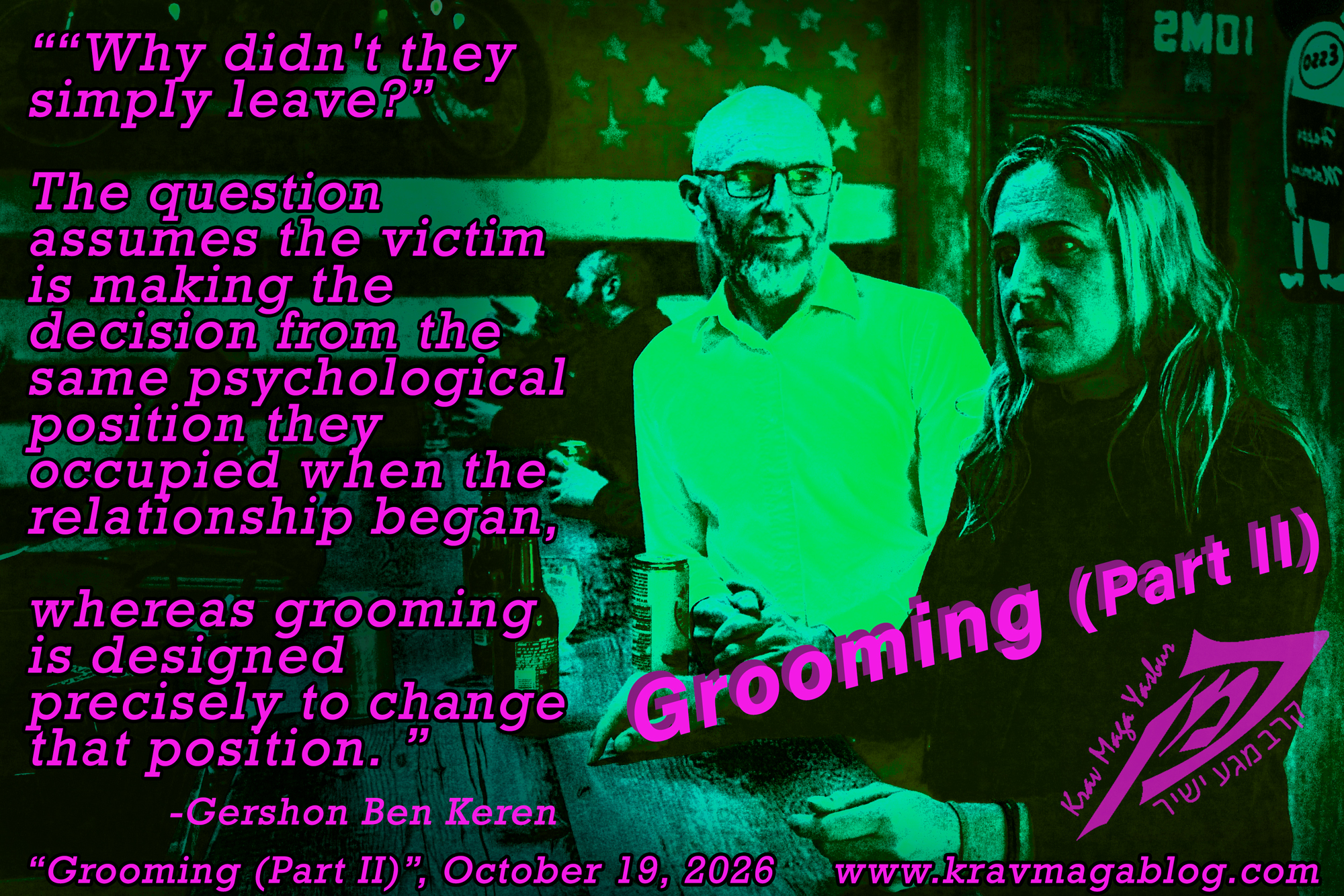
Exploitation occurs when the access, trust, secrecy, dependency, or altered boundaries created during grooming are used for the predator's actual purpose. In sexual grooming this may involve sexual contact, requests for images, or increasingly explicit behavior. In financial exploitation it may mean loans, access to accounts, investments, or repeated requests for money. Criminal grooming can involve persuading someone to transport drugs, hold stolen property, recruit others, or participate in illegal activity. In abusive intimate relationships, exploitation may take the form of coercive control, sexual coercion, financial dependency, and/or physical violence etc. When exploitation is recognized by someone outside the relationship, they sometimes ask the wrong question e.g., “Why didn't they simply leave?” The question assumes the victim is making the decision from the same psychological position they occupied when the relationship began, whereas grooming is designed precisely to change that position. The victim may now feel loyalty, love, guilt, or obligation/responsibility towards their partner. They may worry that nobody will believe them because they previously defended the offender and they may also believe that they have participated in behaviors that can now be used to shame or threaten them etc. What looks from the outside like a single decision may actually be the result of hundreds of smaller decisions that were made under gradually changing circumstances.
It is also worth noting that another reason exploitation can continue is that groomers don't necessarily abandon the behaviors that originally created the trust between them and their target. Kindness and abuse can coexist. A person may exploit someone and then afterwards become affectionate, apologetic, generous, and/or supportive etc. This inconsistency can be deeply confusing because we tend to categorize people as either good or bad. Victims may therefore interpret positive behavior as evidence that an abusive incident was an exception, telling themselves, “That's not who they really are.” The offender may encourage this interpretation of events, using periods of kindness to restore hope and strengthen emotional attachment before then resuming their exploitation. The victim may consequently spend increasing amounts of time trying to recover the relationship they remember from the trust-building stage.
This five-stage model also helps explain why grooming is easier to recognize retrospectively than whilst it is happening. Once exploitation becomes visible, earlier behaviors suddenly acquire a different meaning, e.g., the gift wasn't necessarily just a gift, the private conversations weren't simply evidence of friendship, and the repeated boundary violations weren't isolated misunderstandings etc. Together they form a pattern. However, caution is also important here as individual grooming behaviors are not proof of predatory intent. Healthy relationships also involve trust, intimacy, privacy, and emotional support etc. What should attract our attention is the combination of these behaviors, particularly when they involve increasing secrecy, dependency, exclusivity, boundary testing, and manipulation, coupled with an imbalance of power.
From a personal safety/self-protection perspective, perhaps one of the most useful ways to understand grooming is not as a collection of suspicious personality traits but as a pattern of changing boundaries. Rather than asking ourselves, “Does this person seem like a predator?” we should instead ask, “What is happening to the boundaries in this relationship?” e.g., are requests becoming progressively more intrusive? Is secrecy increasing? Am I becoming increasingly dependent on one person? Does me saying “no” produce guilt, anger, ridicule, or punishment? Does this person repeatedly cross a boundary, apologize, and then cross it again? These questions focus attention on observable behavior rather than attempting to intuit someone's hidden intentions. This is how productive profiling works i.e., it profiles the behaviours not the individual.
At the end of the day, predatory grooming works and succeeds because it exploits behaviors on which healthy human relationships depend. Trust, kindness, reciprocity, and loyalty are not weaknesses as without them, meaningful relationships would be impossible. The problem arises when someone deliberately weaponizes these normal social processes. Just because we understand the grooming process we shouldn't become suspicious of every friendly person or generous gesture. But rather, it should make us more attentive to patterns and we should understand each stage and what it accomplishes e.g., target selection creates access, trust building reduces suspicion, isolation weakens competing influences, whilst desensitization gradually moves boundaries, and exploitation takes advantage of the situation that has been created. Seen this way, grooming is rarely a sudden transformation from safe to dangerous. It is more often a gradual journey in which each step makes the next one easier to accept. Recognizing this progression gives us a better chance of noticing what is happening before exploitation is normalized.